

1. BACKGROUND AND PURPOSE
This concept paper provides a brief on the Artemis Accords — what they are, how they operate, and the potential benefits they could offer the Republic of Mauritius in the event of accession. The paper outlines the nature and legal status of the Accords, their guiding principles, and the areas in which participation could support national space ambitions.
2. WHAT ARE THE ARTEMIS ACCORDS?
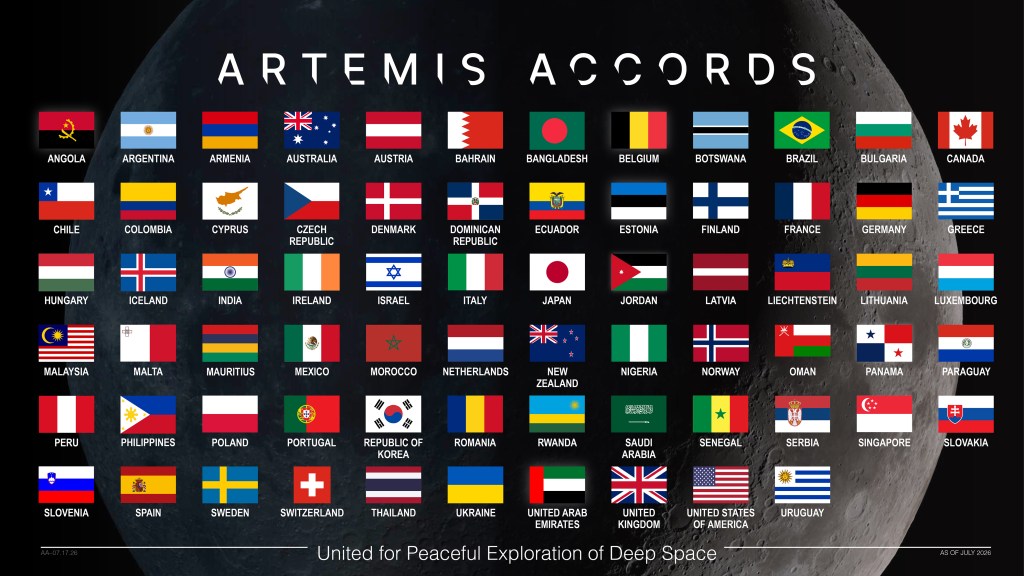
The Artemis Accords are a non-binding, multilateral political framework for the peaceful, transparent, and sustainable civil exploration and use of outer space. They were launched in October 2020 by eight founding nations and have since grown to include 70 signatory nations as of July 2026.
The Accords are grounded in existing international space law — principally the 1967 Outer Space Treaty — and are designed to complement, not replace, multilateral bodies such as the UN Committee on the Peaceful Uses of Outer Space (COPUOS).
Key clarifications regarding the nature of the Accords:
Aspect | Clarification |
|---|---|
Legal status | Non-binding political commitment — not a treaty |
Financial obligations | None |
Technical prerequisites | None Required |
Relationship with US | Multilateral framework — not a bilateral agreement |
Scope | Civil space activities beyond Earth orbit only |
Relationship with COPUOS | Complementary — not a replacement |
3. THE TEN PRINCIPLES OF THE ARTEMIS ACCORDS
The Accords are structured around ten principles applicable to civil space exploration and use:
Principle | Summary |
|---|---|
Peaceful Purposes | All activities must be exclusively for peaceful purposes and in accordance with international law |
Transparency | Open dissemination of national space policies and exploration plans |
Interoperability | Development and use of common technical standards |
Emergency Assistance | Commitment to assist personnel in distress in outer space |
Registration of Space Objects | Consistent with the 1975 Registration Convention |
Release of Scientific Data | Open and timely sharing of scientific results |
Preserving Space Heritage | Protection of historically significant sites and artefacts |
Space Resources | Affirms that resource extraction is permissible under existing international law |
Deconfliction of Activities | Avoiding harmful interference between space actors |
Orbital Debris Mitigation | Responsible planning for end-of-mission disposal |
4. HOW THE ACCORDS OPERATE IN PRACTICE
Signatories participate in the Accords community through:
- Monthly virtual working-level meetings among signatory nations
- Annual workshops to review progress and share experiences
- Principals-level meetings at the International Astronautical Congress (IAC)
- Mission data reporting to the United Nations
- Technical briefings by space agency experts
Cooperation under the Accords may be formalised through Memoranda of Understanding, Agency-to-Agency arrangements, or other bilateral instruments that reference the Accords as their foundation.
5. MAURITIUS SPACE CONTEXT
5.1. National Space Milestones
The launch of MIR-SAT1 in 2021 — the first nanosatellite of Mauritius— marked a defining milestone in the country’s entry into the New Space Era. Since then, the MRIC Space Unit has been actively developing partnerships with international space agencies including JAXA, ISRO, and MBRSC, and has been formulating the Mauritius Space Strategy 2036 to guide the next phase of national space sector development.
5.2. The Mauritius Space Strategy 2036
The Mauritius Space Strategy 2036 establishes a clear national vision:
“To harness space technologies to improve lives, protect the environment, and amplify the voice of SIDS, positioning Mauritius as a regional hub for sustainable, data-driven decision-making and innovation.”
The Strategy is structured around six core objectives:
- Develop national expertise in space and satellite technologies
- Expand the use of satellite data for evidence-based decision-making
- Foster collaborative research and innovation in the space sector
- Strengthen strategic partnerships with global space actors
- Stimulate space-driven entrepreneurship and economic growth
- Build a sustainable and revenue-generating national space capability
6. POTENTIAL AREAS OF RELEVANCE
Should Mauritius consider accession, the following areas of potential relevance have been identified, mapped against the objectives of the Space Strategy 2036:
6.1. International Visibility and Credibility
Signing the Accords sends a clear political signal of a country’s commitment to transparent, peaceful, and responsible space exploration. For Mauritius, this could elevate its profile within the global space governance community and strengthen its positioning as a credible emerging space actor — consistent with the long-term vision of establishing a national space agency.
6.2. Access to a Growing Network of Civil Space Partners
The Accords provide a recognised multilateral framework within which Mauritius could engage with 68 civil space nations. This could complement and deepen existing bilateral partnerships with JAXA, ISRO, and MBRSC, while opening pathways to new partners.
6.3. Capacity Building and Technical Exchange
Participation in monthly working-level meetings and annual workshops could provide structured opportunities for knowledge exchange, technical upskilling, and access to expert networks — directly supporting the Strategy’s objective of developing national expertise in space and satellite technologies.
6.4. Scientific Data Access
Open data sharing under the Accords could help Mauritius use space applications in areas such as:
- EEZ and maritime domain monitoring
- Coral reef and coastal ecosystem management
- Agricultural monitoring
- Cyclone tracking and disaster preparedness
- Sea-level rise and climate resilience
6.5. Space Governance and SIDS Representation
The Accords offer a platform through which Mauritius could contribute to evolving international norms on space governance. This is particularly relevant given the Strategy’s ambition for Mauritius to amplify the voice of Small Island Developing States (SIDS) in the global space regime and to advance the proposed SIDS Space Alliance.
6.6. Geostrategic Positioning
The strategic location of Mauritius in the Indian Ocean has been identified in the Space Strategy as a key asset for space operations — including potential Ground Station-as-a-Service (GSaaS) capabilities and support for satellite re-entry monitoring and eventually Deep Space Research. Membership in the Accords community could enhance the country’s attractiveness as a partner in such operations.
7. THE SIGNING PROCESS — FOR INFORMATION
Should Mauritius decide, following due deliberation, to proceed with accession, the process would involve the following:
- Whole-of-government decision — the relevant ministries determine who signs on behalf of Mauritius
- Signature ceremony — can be hosted in Mauritius, Washington D.C., or another mutually agreed location (e.g. NASA Headquarters, State Department, Embassy, or Ambassador’s residence)
- Media communications — joint media releases from NASA and the U.S. Department of State are issued upon signature
- Repository — the United States serves as the repository of all signatures
8. Mauritius Cabinet of Ministers agrees to sign the Artemis Accords
During their meeting on the 10th of July 2026, Cabinet has agreed to the Ministry of Tertiary Education, Science and Research signing the Artemis Accords and joining the growing community of nations committed to the peaceful, transparent and responsible exploration and use of outer space. The participation in the Artemis Accords would complement Government’s objective of strengthening science, technology, innovation and digital transformation as key enablers of sustainable socio-economic development. The signing ceremony is scheduled on the 17th of July 2026
9. CONCLUSION
The Artemis Accords represent an evolving international framework for civil space governance that is gaining broad global support. Mauritius, as a Small Island Developing State with growing space ambitions and a clear national strategy, may find areas of natural alignment with the principles and community that the Accords represent. At the same time, any decision on accession is a sovereign matter that warrants careful deliberation across government, considering foreign policy considerations, institutional readiness, and national priorities.
